SDI Night/Limited Visibility
The same dive site you know during the day looks completely different after dark. Nocturnal creatures that hide in the daylight come out, bioluminescence lights up the water around you, and your light beam becomes the only reference point you have. The SDI Night/Limited Visibility Diver course trains you to navigate that environment safely, covering lighting equipment, buddy contact in the dark, navigation without visual reference, disorientation procedures, and emergency protocols for night and low-visibility conditions. Open to certified Open Water divers, ages 10 and up. Counts as one specialty credit toward the SDI Advanced Diver rating.
Students must own their own mask, fins, boots, and snorkel for this course.
All students receive a discount on product purchases during enrollment of any one of our courses!
Have Classwallet/ESA funds? Click Here.
Are you a Veteran with a GI Bill? Click here.
Availability: Contact us for booking information
SDI Night/Limited Visibility Diver Course
Turn off your light for a moment on a night dive and the water comes alive. Bioluminescent plankton flicker where your hands move. The reef you know from daytime looks nothing like what you find after dark. Octopus, lobster, moray eels, and creatures that spend daylight hours hiding are out and active. It is one of the most distinct experiences diving offers, and it happens at the same sites you already dive.
The SDI Night/Limited Visibility Diver course prepares you for it. You will learn how to plan and execute night dives safely, how to navigate without visual reference points, how to maintain buddy contact in the dark, and how to manage the specific emergencies that night and low-visibility diving can present. The course covers both night diving and limited visibility conditions, which apply any time particulate, surge, or poor water clarity reduces your sightlines regardless of time of day.
What the Course Covers
Lighting Equipment
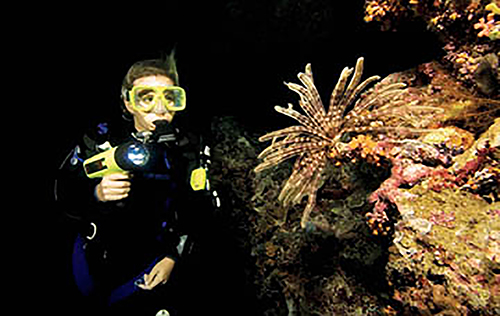
Your primary dive light is your reference point, your navigation tool, and your communication device all in one. The course covers the types of dive lights used for night diving, how to evaluate primary versus backup light options, and personal dive beacons, which attach to your gear and make you visible to your buddy when your primary light is pointed away. Backup lighting is not optional on a night dive, and the course treats it that way.
Buddy System and Communications in the Dark
Staying with your buddy in daylight is straightforward. In the dark, it requires deliberate technique. The course covers buddy contact methods specific to night diving, light signal conventions used for diver-to-diver communication underwater, and how to maintain awareness of your buddy's position when neither of you has the visual range you have during the day.
Navigation Without Visual Reference
Night navigation relies more heavily on compass, bottom contour, and reference points than daytime diving. The course covers compass navigation in low light, how to use bottom contour and terrain features to maintain orientation, and how to use marker lights and strobes at entry and exit points so you can find your way back to the boat or shore. Specific navigation patterns are practiced during the dive, including direction changes while maintaining position and a two-minute navigation swim without compass reference.
Disorientation and Emergency Procedures
Disorientation is more common in low visibility than in any other diving condition, and the consequences of a lost buddy or light failure at night require a different response than the same situation in daylight. The course covers what to do if you become disoriented, how to respond to a separated buddy in the dark, what to do when a light fails underwater, and emergency procedures for a disabled or lost diver in night conditions.
Nocturnal Marine Life
The underwater environment changes significantly after dark. Many species that are inactive or hidden during the day come out to feed at night. The course covers what to expect from nocturnal marine life, how to observe it without disturbing it, and why a night dive at a familiar site often feels like a completely new location.
In-Water Skills
The course includes a night open water dive. Required skills include:
- Planning the dive including entry and exit points, buddy plan, and light signals
- Safe entry and descent in darkness
- Remaining submerged for a minimum of 20 minutes
- Changing direction multiple times while maintaining proper navigation
- Two-minute navigation swim without compass
- Surfacing and reorienting to the exit point
- Descending and navigating back underwater
- Proper use of underwater light, submersible pressure gauge, compass, depth gauge, and computer
- Maintaining buddy contact throughout the entire dive
- Logging the dive
Night Diving Near Phoenix: Lake Pleasant
Lake Pleasant is the primary open water training site for Dive Arizona and a regular night diving destination. At 1,700 feet elevation with reliably clear water and no marine traffic after dark, it is one of the more accessible freshwater night dive sites in the region. If you complete this course, you leave with the certification and the skills to night dive Lake Pleasant and any comparable site. Call us at (480) 881-4013 and we can talk through current conditions and access.
Who Can Enroll
The SDI Night/Limited Visibility Diver course is open to certified SDI Open Water Scuba Divers or equivalent. Minimum age is 10 with parental consent, 18 without.
Counts Toward the SDI Advanced Diver Rating
The SDI Night/Limited Visibility Diver certification counts as one specialty credit toward the SDI Advanced Diver Development Program.
Gear and Equipment
Students are required to own their own mask, fins, boots, and snorkel for this course. Dive gear rental such as BCD, regulator, computer, tanks, weights, and wetsuit is included in the course. If you'd like to purchase any of your own equipment, we carry a full selection in the shop and all students enrolled in a course receive a discount on purchases during enrollment.
Frequently Asked Questions
What does the SDI Night/Limited Visibility Diver course cover?
The course covers lighting equipment selection and backup lighting, buddy contact and communication techniques in the dark, compass and terrain navigation at night, disorientation procedures and emergency protocols for night conditions, and nocturnal marine life behavior. The in-water component includes a night open water dive with specific navigation and buddy skills.
Is night diving scary?
Most divers say night diving feels different than they expected, and the difference is usually positive. The darkness limits your field of view, which concentrates your attention on what is directly in front of you. Nocturnal creatures that are absent during the day are active and visible. The course builds the specific skills and procedures that make night diving feel controlled rather than disorienting.
What equipment do you need for night diving?
A primary dive light and a backup light are the minimum. A personal beacon or strobe attached to your gear makes you visible to your buddy when your light is pointing in another direction. Everything else is standard scuba equipment. The course covers how to evaluate and choose dive lights for night diving.
Can you night dive at Lake Pleasant?
Yes. Lake Pleasant is a regular night diving destination for Dive Arizona divers. At 1,700 feet elevation with clear water and no boat traffic after dark, it is one of the more accessible freshwater night dive sites in the Phoenix area. Call us at (480) 881-4013 for current conditions and access information.
What is limited visibility diving?
Limited visibility diving refers to any condition where particulate, surge, silt, algae bloom, or poor water clarity significantly reduces your sightlines underwater, regardless of time of day. The techniques covered in this course, including navigation by terrain and compass, maintained buddy contact, and disorientation procedures, apply in any low-visibility environment, not just at night.
Does the Night/Limited Visibility certification count toward SDI Advanced Diver?
Yes. The SDI Night/Limited Visibility Diver certification counts as one of the four specialty credits required for the SDI Advanced Diver Development Program.
Ready to See the Reef After Dark?
Contact us to schedule the SDI Night/Limited Visibility Diver course. Call us at (480) 881-4013 or stop by the shop. We are open Monday through Saturday 11am to 6pm and Sunday 11am to 5pm, at 18618 S 186th Way, Queen Creek, inside The Shooting Range.
For more information and to see course standards, click here!