SDI vs. PADI vs. SSI vs. NAUI: What the Agency on Your Card Changes
Amanda Krugen Aug 18, 2026
SDI vs. PADI vs. SSI vs. NAUI: What the Agency on Your Card Changes
If you've started looking into getting certified, you've probably run into four names: PADI, SDI, SSI, and NAUI. Course brochures rarely explain what separates them, so it's easy to assume picking the wrong one limits where you can dive later. It doesn't. Here's what the agency on your card changes, and what it doesn't.
Your Card Works Everywhere, No Matter Which Logo Is on It
All four agencies belong to the World Recreational Scuba Training Council, formed in 1999 to set baseline training standards for entry-level certification. That's why a dive shop in Cozumel doesn't care whether your Open Water card says PADI or SDI. Minimum skills, depth limits, and dive counts are aligned across agencies, so your card gets you the same rental gear, boat seats, and training access anywhere in the world.
Where the Four Agencies Differ
NAUI is the oldest of the four, founded in 1959 by Albert Tillman and Neal Hess, and it's the only major agency that's a nonprofit, governed by its own instructor members through an elected board. It was also one of the first to publish technical diving standards, back in 1997, developing decompression tables with physicist Bruce Wienke.
PADI came next, founded in 1966 by John Cronin and Ralph Erickson, and grew into the largest training organization in the world. PADI pioneered standardized, multimedia course materials decades before that was common, and its name is on more dive shop windows worldwide than any other agency.
SSI followed in 1970, founded by Robert Clark, and runs on a different model. SSI instructors can only teach through SSI-affiliated dive centers or resorts, not independently, which is why you'll see it so often at destination resorts with their own dive operations.
SDI is the newest, launched in 1998 as the recreational sister to TDI, the technical diving agency, and ERDI, which trains public safety divers. SDI built its curriculum around modern dive computers from day one instead of paper tables, and it's one of the few agencies that recognizes solo diving as a trainable specialty.
Why Dive Arizona Teaches SDI
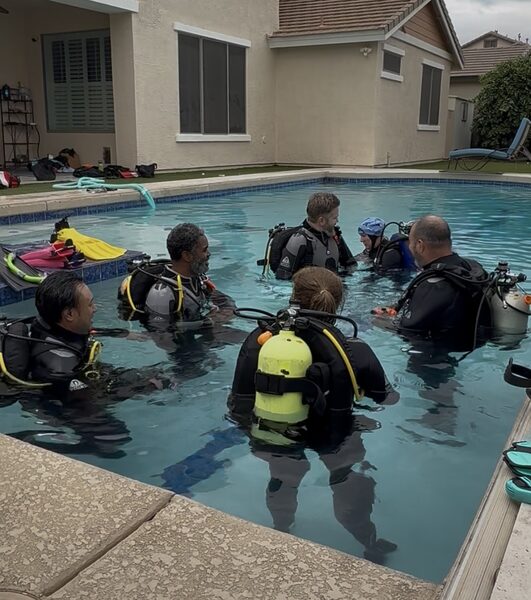
We chose SDI because its structure matches how people dive today. Nobody plans a real dive on a paper table anymore, so we train you on the computer you'll use from day one. SDI's flexible skill standards also let us teach at the pace that fits each diver, giving more time to someone who needs it instead of forcing every student through the same rigid timeline.
There's a relationship behind the agency too. When we call SDI's headquarters, we get someone who knows us, not a call center, and it feels like family after years of working together. SDI also opens directly into TDI's technical diving track without switching agencies. None of that makes another agency wrong, it's the fit that made sense for us.
What Matters More Than the Agency: A Good Instructor
If you're not planning to go professional, the biggest factor in a good class isn't the agency on your card, it's who's teaching it. Every agency, ours included, has instructors who go above and beyond and instructors who rush the minimum. The agency sets the standard, so choose the instructor who's going to meet and exceed those standards.
Look for someone who follows their agency's standards and goes above and beyond to make sure you're comfortable, giving you quality instruction instead of rushing through the class. Bottom line, a great instructor will provide a great class.
When Choosing an Agency Matters
For recreational diving, the agency on your card is close to irrelevant. That changes once you go professional. A Divemaster rating, and every level after it, is tied to the agency that issued it.
Earn a Divemaster through PADI and want to work at an SDI shop like ours? You can't just show up and teach, you'd need a professional crossover first. Choose the agency used by the shop you want to work for.
Already Certified With PADI, NAUI, or SSI? You Don't Need to Start Over
If you're already certified, your card works here exactly as it should. Dive with us, join our trips, and enroll in continuing education like the Advanced Diver rating or any specialty course, no crossover paperwork required. Want to teach under our SDI affiliation instead? That's a professional crossover, mostly self-paced eLearning plus a short seminar.
Ready for Your Next Certification?
Whether you're starting from zero with an Open Water course or you're already certified elsewhere and ready for what's next, call the shop and we'll get you scheduled.
Call (480) 881-4013Or visit us to get started.
Frequently Asked Questions
None of the four major agencies is objectively better. PADI, SDI, SSI, and NAUI all meet the same baseline training standards set by the World Recreational Scuba Training Council. The differences come down to teaching style, organizational structure, and which one a given shop is built around.
Yes. Any Open Water certification from a WRSTC-member agency is honored here. You can join our dives and trips and enroll in continuing education without any extra steps.
No. Certified divers keep their certification for life regardless of which shop they train with next. Switching to a shop that teaches a different agency doesn't require redoing anything you've already completed.
It depends on where you want to work. If you want to teach at an SDI-affiliated shop like ours, you'd complete a professional crossover, which is mostly self-paced eLearning plus a seminar rather than a full re-certification.
SDI trains divers on modern dive computers from the first open water dive instead of paper tables, and it connects directly into technical diving through TDI if you want to go further. It fits how we teach, not a judgment on other agencies.
No. All four are held to the same minimum entry-level standards through the World Recreational Scuba Training Council. Safety comes down to the individual instructor and shop, not the logo on the certification card.
Written by Amanda Krugen, SDI Instructor Trainer and TDI Instructor at Dive Arizona.